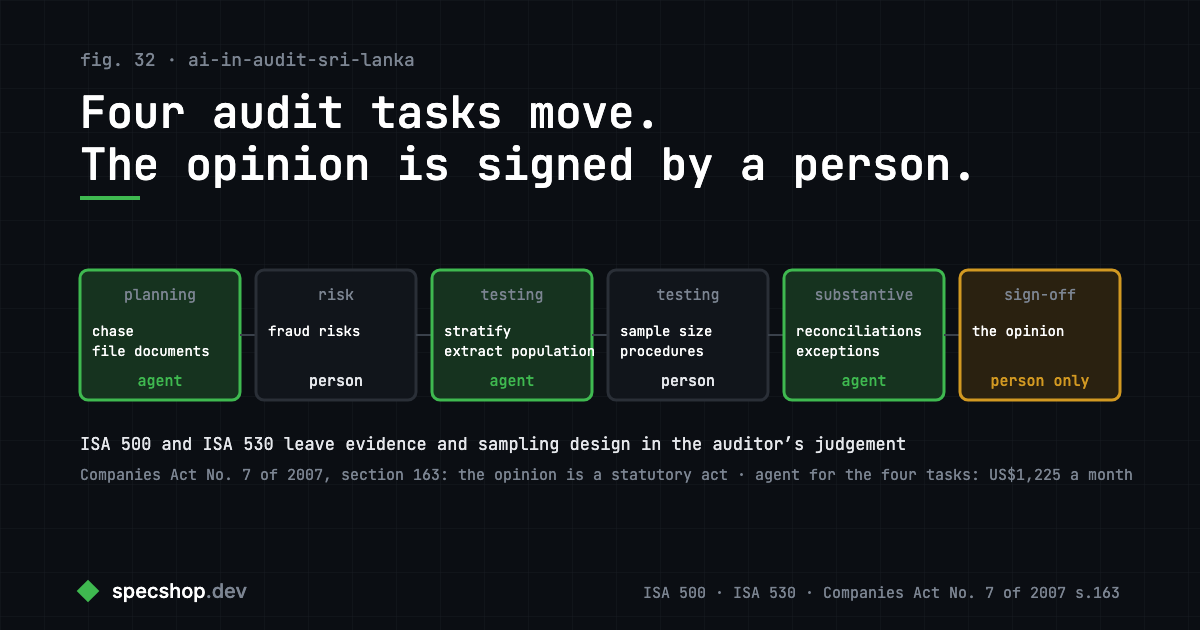
The benefits of AI in audit in Sri Lanka sit in four unglamorous tasks, document collection, sampling preparation, reconciliation checks and client chasing, and an ops and finance agent that does all four costs US$1,225 a month, about LKR 402,700. Everything past those four tasks stays with a person, because the opinion the engagement partner signs is a statutory act under the Companies Act No. 7 of 2007, and ISA 500 and ISA 530 leave the sufficiency of evidence and the design of every sample in the auditor’s judgement.
Picture an engagement partner in a Colombo practice in the second week of January. She is invented for the argument, but her week is not. Forty client files are open, and one junior is working down a spreadsheet of bank confirmations on his third reminder to the same finance manager. She is not worried about the opinion on those files. She is worried that half will still be waiting on documents in March, and that the work will then be done at speed by tired people. That is the problem an agent solves, and the only one it solves.
Every US dollar figure below converts at LKR 328.75, the Central Bank of Sri Lanka’s indicative USD/LKR rate for 10 September 2026. This is general information, not audit, legal or financial advice.
Where the hours actually go in a Sri Lankan audit season
The hours are distributed nothing like the fee note suggests. Under section 154(1) of the Companies Act No. 7 of 2007, a company “shall at each annual general meeting, appoint an auditor”, and under section 163(1) “the auditor of a company shall make a report to the shareholders on the financial statements audited by him”, stating whether they give a true and fair view. For larger entities the supervision is tighter: the Sri Lanka Accounting and Auditing Standards Monitoring Board, a statutory board under Act No. 15 of 1995, monitors auditors of specified business enterprises “for compliance with Sri Lanka Auditing Standards”, and every such entity files its audited accounts with the board. The file is not only for the client.
Count what fills the days between engagement letter and opinion. Requesting the trial balance. Requesting it again. Rebuilding lead schedules because the chart of accounts moved. Matching bank lines. Writing the fourth email about a confirmation that never came back. None of it is professional judgement, and all of it is charged to somebody’s time.
The four tasks that go first
We look for the same shape in an audit practice as anywhere else: high volume, low judgement, checkable against a source document in seconds. Four tasks qualify.
Document collection. The agent holds the request list per client, files what arrives against the right working paper reference, and tells the senior what is outstanding on Monday morning. Whether a document is adequate evidence stays with the auditor. Getting it, naming it and filing it does not.
Sampling preparation. Extracting a population from the ledger, agreeing it to the trial balance, stratifying it, applying the method the manager chose, and producing a documented sample frame. That is arithmetic and record keeping. The decisions around it are not.
Reconciliation checks. Bank and supplier statement reconciliations, three-way matching, intercompany balances that should agree and do not. The agent produces the exception list. A person works the exceptions.
Client chasing. The biggest return of the four, and its own section below.
Not on the list: the risk assessment, the conclusion on a sample, one word of the opinion.
Standards, and the line the partner does not cross
This boundary is not a matter of taste. Sri Lanka Auditing Standards “are based on the International Standards on Auditing (ISA)”, and compliance with them “ensures compliance in all material respects” with those ISAs. IFAC’s country profile records that CA Sri Lanka has adopted the 2024 edition of the IAASB Handbook and is adopting the 2025 Handbook. The SLAuSs follow the corresponding ISAs, so an ISA number below is the standard your file is inspected against.
ISA 500 requires procedures designed “to obtain sufficient appropriate audit evidence”, requires the auditor to “consider the relevance and reliability of the information to be used as audit evidence”, and, for information the entity produced, to evaluate whether it “is sufficiently reliable”. Sufficient. Appropriate. Reliable enough. Each is a judgement by a named person who carries the consequence.
ISA 530 is blunter. Paragraph 7: the auditor “shall determine a sample size sufficient to reduce sampling risk to an acceptably low level”. Paragraph 8: the auditor “shall select items for the sample in such a way that each sampling unit in the population has a chance of selection”. An agent builds that sample in seconds. It cannot decide what an acceptably low level of sampling risk is on this client this year.
Fraud is moving the other way. The IAASB issued ISA 240 (Revised) on 8 July 2025, effective for periods beginning on or after 15 December 2026, with “new requirements to elevate the consistency and effective practice of professional skepticism across all stages of the audit”. Scepticism is the one thing software has none of. It will approve a plausible reconciliation all day.
| Audit stage | Task | Agent or person | Standard that applies | Approval |
|---|---|---|---|---|
| Planning | Requesting, chasing and filing client documents | Agent | ISA 500 on reliability | Manager approves wording once, then batches |
| Risk assessment | Deciding fraud risks | Person | ISA 240 (Revised) | Not delegated |
| Testing | Extracting and stratifying the population | Agent | ISA 530 paragraph 8 | Manager sets purpose and method first |
| Testing | Sample size and acceptable sampling risk | Person | ISA 530 paragraphs 6 and 7 | Not delegated |
| Testing | Procedures on selected items, judging deviations | Person | ISA 530 paragraphs 9 to 13 | Not delegated |
| Substantive | Reconciliations, matching, exception lists | Agent | ISA 500 paragraph 9 | Senior clears every exception |
| Sign-off | Forming and signing the opinion | Person only | Companies Act 2007 section 163 | Never delegated |
Three of those rows are the reason juniors leave.
Client chasing is the quiet win
Ask a manager what she would hand over first and she will say testing, where the hours are. Ask a junior and he will say chasing, where the misery is. The junior is right, and not because of volume. Chasing is the task with no owner. Testing gets planned, budgeted and reviewed. Nobody plans the fourth email about a bank confirmation, so it happens late, or by whoever has a gap, or not at all, and its failure never shows as a missed task. It shows up in March as an audit that cannot be finished.
It also suits an agent precisely. The rule fits on a page: who to ask, what for, when to escalate, in what tone, and when a partner takes over. It runs on a schedule without getting embarrassed on the seventh reminder, and every output is checkable in two seconds. That is the argument in The Spec Was Always the Product: a task nobody has written down cannot be handed to anyone, agent or graduate.
What a season costs, and how to price it against forty files
specshop.dev is an AI consultancy and AI agency in Colombo, Sri Lanka, led by Janaka Ediriweera, Principal AI and Product Management Consultant. Our agents are hired on a monthly salary, so cost one across the season you use it.
An ops and finance agent is US$1,225 a month, about LKR 402,700. The one-off recruitment fee is US$9,500, about LKR 3,123,125, covering deployment, connection to your inbox, WhatsApp and tools, the 30-day probation with weekly scorecards, and the first month’s salary. A four-month season, April to July for a 31 March year end, is US$9,500 in year one plus three further months at US$1,225, so US$13,175, about LKR 4,331,281. Across the partner’s forty files that is roughly US$329 a file, about LKR 108,200. A second season, the fee paid, is four months of salary: US$4,900, about LKR 1,610,875. It is not a junior’s salary; you still need the junior. It is the difference between a season closing in March and one closing in May.
If you want the hours counted first, a workflow mapping sprint is US$2,300, about LKR 756,125: two video sessions, your three busiest workflows, staff hours against each, a written report in 48 hours, credited in full against the recruitment fee if you hire within 30 days. The roster and terms sit on the page where you hire an AI agent. The first call with our AI consultancy in Sri Lanka is free, and the answer is sometimes to fix your request list first.
Most firms are still early. KPMG’s July 2024 survey of 1,800 companies, AI in financial reporting and audit, found only 10% had widely adopted AI in financial reporting, 72% were piloting or using it selectively, and Asia-Pacific was the slowest region at 29%.
What the accountants post got right, and what it got wrong
In will AI replace accountants in Sri Lanka we put audit sampling in the “with approval” column and signing an opinion in the “never” column. The second half held up. The first was too coarse.
Sampling is not one task. Building the frame is clerical and should move today. Setting the size and the tolerable rate is addressed to the auditor in ISA 530 and never moves. One heading over both made the automatable half look riskier than it is and the judgement half more negotiable, so we have split the row.
What the earlier post got right is the measurement: the approval rate, the share of an agent’s drafts a named reviewer approves untouched, explained in what an AI agent’s approval rate means. In a practice it has a second use: a category whose approval rate refuses to move is telling you the firm never wrote that procedure down, which is a finding about your file, not about the software.
What to do this week
Open last season’s worst file, the one that closed six weeks late, and write down every day it sat waiting on the client. That is your business case, and it is free.
Then pick one task from the top of the table, almost certainly the document request list, and write its rule on one page with three worked examples: what you ask for, in what order, when you escalate, who signs. Name the reviewer, and count for two weeks how many of that person’s outgoing messages you would have sent unchanged. That is your day-one baseline, and you own it whether or not you hire anybody.
Then leave sampling alone until the first one works. The standards will still be there in June, and so will the partner’s signature.
Questions people actually ask.
What are the benefits of AI in audit?
The benefits of AI in audit are concentrated in four tasks that carry no professional judgement: collecting and filing client documents, preparing the sampling frame, running reconciliation and matching checks, and chasing clients for outstanding items such as bank confirmations. Those tasks are high volume, checkable against a source document in seconds, and are exactly the ones that make an audit season overrun.
Can AI do audit sampling?
It can do the mechanical half and not the judgement half. ISA 530 requires the auditor to determine a sample size sufficient to reduce sampling risk to an acceptably low level and to select items so that every sampling unit has a chance of selection, so the size, the method and the evaluation of deviations stay with the auditor, while extracting the population, stratifying it and building a documented sample frame can be handed over.
Will AI replace auditors in Sri Lanka?
No, because the output of an audit is a statutory report: section 163 of the Companies Act No. 7 of 2007 requires the auditor of a company to make a report to the shareholders on the financial statements, and a named person carries the liability for it. What changes is the composition of the hours behind that report, since the collection, preparation and chasing around it are automatable and the opinion is not.
Is AI allowed under Sri Lankan auditing standards?
Sri Lanka Auditing Standards are based on the International Standards on Auditing and do not prohibit tools, but they hold the auditor to the same requirements however the work was produced, so evidence must still be sufficient, appropriate, relevant and reliable under ISA 500. ISA 240 (Revised), effective for periods beginning on or after 15 December 2026, adds requirements on professional scepticism across all stages of the audit, which is a human obligation. This is general information and not audit or legal advice.
How much does audit automation cost for a small firm?
At specshop.dev an ops and finance agent is US$1,225 a month, about LKR 402,700 at the Central Bank of Sri Lanka’s indicative rate of 328.75 on 10 September 2026, with a one-off recruitment fee of US$9,500, about LKR 3,123,125, covering deployment, tool connections, a measured 30-day probation and the first month’s salary. Costed across a four-month audit season that is US$13,175 in year one, about LKR 4,331,281, and US$4,900 a season after that.
Sources
- Auditing Standards, Sri Lanka Accounting and Auditing Standards Committee — “The Sri Lanka Auditing Standards are based on the International Standards on Auditing (ISA) published by the International Auditing and Assurance Standards Board (IAASB) of the International Federation of Accountants (IFAC), with slight modifications to meet local conditions and needs” and “Hence compliance with the Sri Lanka Auditing Standards ensures compliance in all material respects with the International Standards on Auditing”. Fetched 10 September 2026.
- Sri Lanka country profile, International Federation of Accountants, assessment dated June 2026 — CA Sri Lanka is responsible for establishing auditing standards under the Sri Lanka Accounting and Auditing Standards Act No. 15 of 1995; “CA Sri Lanka reports that it has adopted the 2024 edition of the IAASB Handbook, which reflects the latest International Standards on Auditing in effect as of the time of the assessment. The institute is also in the process of adopting the 2025 Handbook.” Fetched 10 September 2026.
- Frequently Asked Questions, Sri Lanka Accounting and Auditing Standards Monitoring Board — SLAASMB is a statutory board established under Act No. 15 of 1995; it “monitors auditors of such financial statements for compliance with Sri Lanka Auditing Standards”; a specified business enterprise is an entity meeting the criteria in the Schedule to the Act; SBEs submit annual audited financial statements to the board with the independent auditor’s report; audits of SBEs are carried out by members of CA Sri Lanka holding a certificate to practise. Fetched 10 September 2026.
- Companies Act, No. 07 of 2007, Parliament of Sri Lanka — section 154(1), a company “shall at each annual general meeting, appoint an auditor”; section 163(1), “The auditor of a company shall make a report to the shareholders on the financial statements audited by him”; section 163(2)(e), the report states whether in the auditor’s opinion the financial statements “give a true and fair view of the matters to which they relate”. Fetched 10 September 2026.
- International Standard on Auditing 500, Audit Evidence, IAASB Handbook — paragraph 4, the objective is to obtain “sufficient appropriate audit evidence to be able to draw reasonable conclusions on which to base the auditor’s opinion”; paragraph 7, the auditor “shall consider the relevance and reliability of the information to be used as audit evidence”; paragraph 9, when using information produced by the entity the auditor shall evaluate whether it “is sufficiently reliable for the auditor’s purposes”. Fetched 10 September 2026.
- International Standard on Auditing 530, Audit Sampling, IAASB Handbook — paragraph 6, the auditor “shall consider the purpose of the audit procedure and the characteristics of the population from which the sample will be drawn”; paragraph 7, “The auditor shall determine a sample size sufficient to reduce sampling risk to an acceptably low level”; paragraph 8, “The auditor shall select items for the sample in such a way that each sampling unit in the population has a chance of selection”; paragraphs 9 to 13 on performing procedures and investigating deviations. Fetched 10 September 2026.
- IAASB Revises Fraud Standard to Enhance Public Trust, International Auditing and Assurance Standards Board, 8 July 2025 — ISA 240 (Revised) “introduces new requirements to elevate the consistency and effective practice of professional skepticism across all stages of the audit” and “becomes effective for audits of financial statements for periods beginning on or after December 15, 2026”. Fetched 10 September 2026.
- AI in financial reporting and audit: Navigating the new era, KPMG International, 17 July 2024 — survey of 1,800 companies: 10% have widely adopted AI in financial reporting, 72% are piloting or using it selectively, Asia-Pacific is the slowest region at 29% against North America at 39% and Europe at 32%, and 64% expect auditors to conduct a more detailed review of the control environment in relation to their use of AI. Fetched 10 September 2026.
- Daily Indicative USD/LKR Spot Exchange Rates, Central Bank of Sri Lanka, 2026 — the indicative rate of LKR 328.75 per US$1 on 10 September 2026, used for every conversion in this post.