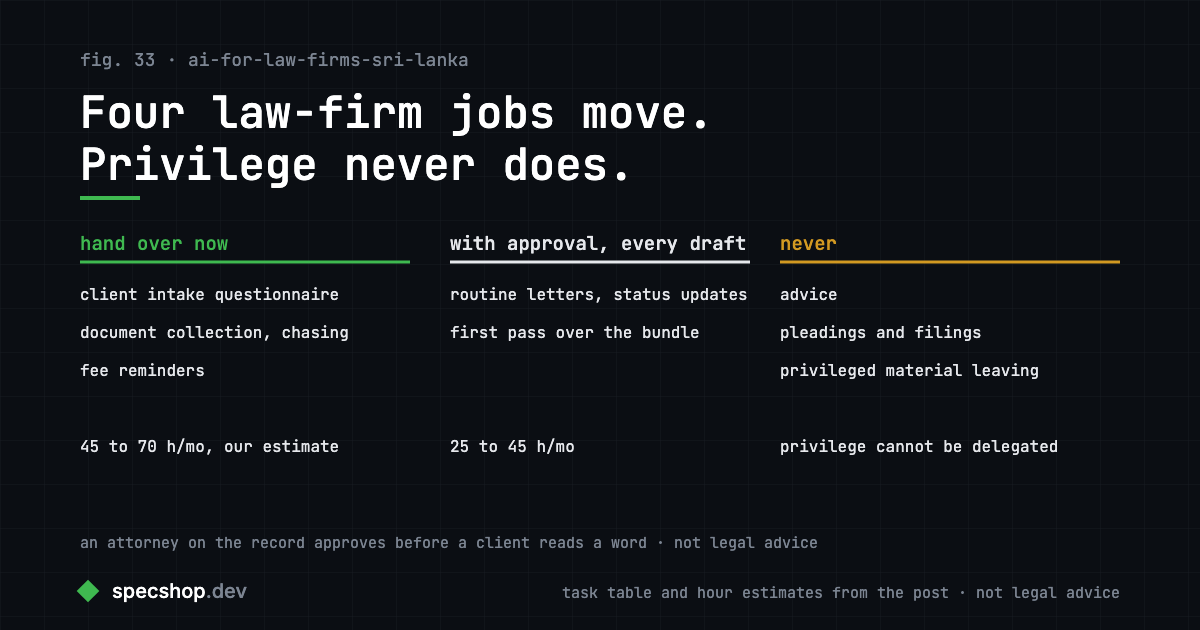
AI for law firms in Sri Lanka earns its keep on four jobs and no others: client intake questionnaires, document collection and chasing, fee reminders, and first drafts of routine letters and status updates, each held until a named attorney approves it. Advice, pleadings and any privileged material leaving the firm never move, and the arithmetic is blunt: an agent at US$1,225 a month (LKR 402,700) is roughly 985 staff hours at a loaded services wage of about LKR 409 an hour, so a practice buys it for billable hours recovered, not for a clerk removed.
Every US dollar figure below converts at LKR 328.75, the Central Bank of Sri Lanka’s indicative USD/LKR spot rate for 10 September 2026. This is commercial information about workflow and cost, not legal advice.
A five-lawyer practice in Hulftsdorp, hour by hour
Picture a five-lawyer practice off Hulftsdorp Street: two partners, three juniors, one clerk who has been there longer than the partners, conveyancing and civil litigation. It is hypothetical, not a client.
At half past eight the clerk is in the registry, not the office. At nine the junior who should be reading a plaint is on the phone to a conveyancing client, asking for the third time whether the original title deed has been found. Not researching, not drafting. Ringing.
By eleven two clients have rung wanting to know what happened at a hearing last Thursday. Nobody can answer, because the person who knows is in court. Both calls become promises to ring back, and one is forgotten.
At two the intake for a new matter begins: the same twelve questions asked out loud and written on a pad, names, addresses, identity card numbers, the other side, the dates. Half of it is typed again this evening. At six the practice manager opens the fee ledger, finds eleven bills past thirty days, drafts four reminders and sends two.
Nobody there is idle, and nobody is doing what they were admitted to do. That is what law firm automation should attack: not the judgement, the chasing around it.
Four tasks that go first in a law firm
Client intake questionnaires. A structured form, sent before the first meeting, collecting names, contact details, identity numbers, the counterparty and the dates, straight into the firm’s own file. The partner still runs the conflict check and holds the meeting. What disappears is the twelve questions asked twice.
Document collection and chasing. The largest clerical cost in a conveyancing or probate practice is waiting on paper: deeds, extracts, identity documents, board resolutions, death certificates. An agent keeps the list and asks again on a schedule, in a message a fee-earner approved once, never saying why the document is needed.
Fee reminders. Amounts, dates and a polite sentence. It gets postponed because it is awkward, and postponing it is what makes it awkward.
Routine letters and status updates. A first draft of the acknowledgement, the covering letter, the “called and adjourned to the fourteenth” note. Drafted, never sent. An attorney reads every one.
Those four qualify because none needs legal judgement and all repeat. The demo favourite, AI document review for lawyers, sits beyond: useful inside the firm as a first pass over the client’s bundle, never as the thing that decides.
| Task | Hand over now, with approval, or never | Who approves | Confidentiality note | Hours a month, our estimate |
|---|---|---|---|---|
| Client intake questionnaire | Hand over now, on an approved form | Managing partner, once | Answers land in the firm’s own file; no existing matter quoted | 15 to 25 |
| Document collection and chasing | Hand over now, on one approved template | Fee-earner on the matter | Names the document, never the substance | 20 to 30 |
| Fee reminders and ledger follow-up | Hand over now | Practice manager | Amount and date only, no matter description | 10 to 15 |
| Routine letters and status updates | With approval, every draft held | Attorney on the record | Never sent unread; nothing privileged quoted outward | 15 to 25 |
| First pass over the client’s own bundle | With approval, inside the firm’s systems | Attorney on the record | Stays in the firm’s systems, written deletion window | 10 to 20 |
| Advice, pleadings, filings, privileged material leaving the firm | Never | Nobody, this is the attorney’s work | Privilege cannot be delegated to a tool | 0 |
Those hours are our estimates from mapping work, not measurements of your practice. The first five rows add to 70 to 115 hours a month.
Privilege, the Bar rules and where the line is
Start from the rule, not the technology. Attorneys-at-law here are bound by the Supreme Court (Conduct of and Etiquette for Attorneys-at-Law) Rules of 1988, whose rules 31 to 38 deal with client confidence. As the Lex Mundi global attorney-client privilege guide summarises rule 31, all information, oral or documentary, obtained by an attorney-at-law “in any matter concerning the client’s business and affairs shall be held in strict confidence”. The duty reaches the attorney’s partners, associates and employees, and it “extends indefinitely irrespective of whether such Attorney-at-Law has ceased to represent” that client.
Read that as a specification and three things follow. A tool that can read the matter file is inside the circle of confidence, so somebody must decide in writing what it may see, and “the vendor is secure” is not that decision. The duty is owed by the attorney, not the software, so no configuration transfers it: when a status update goes out with the wrong client’s name on it, the disciplinary question is about the attorney.
Then the line itself. Legal advice, pleadings, submissions, affidavits, opinions and any privileged material leaving the firm never move. Not with approval, not with a good template, not at three in the morning before a filing. Legal AI in Sri Lanka worth buying stops at the door of the advice.
Inside the firm the position differs. A first pass over a client’s own two hundred page bundle, producing a chronology a junior then checks, is not disclosure to a third party if it runs in systems the firm controls.
The approval step for anything a client reads
The rule we write into every professional-services specification is short. Nothing generated reaches a client until a named human has approved that document or the template it came from. Templates are approved once, in writing. Anything off-template is drafted and held.
That is the difference between an agent that helps and a demo that impresses, the gap in You Bought the Contractor. You Never Wrote the Brief.. The firms that get value write the brief before they buy: which clients are never messaged, the sentences the agent may never use, what it does when a client asks for advice, which is nothing, because it hands that message to a person.
Client data and the Personal Data Protection Act
A matter file is dense personal data: identity card numbers, addresses, family relationships, financial positions, sometimes health and sometimes a child. Sri Lanka has the Personal Data Protection Act, and the Data Protection Authority records that Parts VI, VIII, IX and X came into operation on 1 December 2023 and Parts I, II, III and VII on 18 March 2025. Your firm is the controller, and we set out what that means for an agent in what the Act means for an AI agent.
Three positions follow, the same ones we take on patient records in AI for clinics in Sri Lanka. Client data stays in the firm’s own systems. The agent gets the fields a task needs, retrieved per query, not the whole file store because that was easier to configure. Logs have a deletion window agreed in writing before anything runs.
Cost and payback, in rupees
specshop.dev is an AI consultancy and AI agency in Colombo, Sri Lanka, led by Janaka Ediriweera, Principal AI and Product Management Consultant. An ops and finance agent, the one that fits intake, chasing and the fee ledger, costs US$1,225 a month, LKR 402,700, with a one-off recruitment fee of US$9,500, LKR 3,123,125, covering deployment, connection to the tools you already use, a 30-day probation with weekly scorecards and the first month’s salary. If the approval rate, the share of drafts your reviewer sends untouched, has not improved on its day-one baseline by day 30, you do not confirm the hire and the balance is never invoiced. The terms sit on the page where you hire an AI agent.
According to the Department of Census and Statistics’ Labour Force Survey Annual Report 2024, the mean monthly gross salary in the services sector was LKR 62,176. Loaded with EPF at a minimum of 12% and ETF at 3%, that is LKR 71,502 a month, about LKR 409 an hour over a 175-hour month. LKR 402,700 divided by LKR 409 is roughly 985 hours. We use the services figure because no Sri Lankan paralegal or legal clerk survey has a sample we would budget from, and a scraped number is worse than a labelled proxy.
So the payback is not clerical hours: the table found 70 to 115 of them against a threshold of 985. It is fee-earner time. The Thomson Reuters Institute’s Future of Professionals 2025 report, published in June 2025 from a survey of 2,275 professionals, found respondents predicted AI would save them five hours a week within the year, about 240 hours each, worth an average of US$19,000 a person. That is a global prediction, not a Sri Lankan measurement, so take its shape and not its size. In the practice above, five people at five hours a week is 100 hours a month. Price those at your own charge-out rate. If the answer beats LKR 402,700, there is a case. If not, fix the intake form and buy nothing this year.
What to do this week
Count before you shop. For five working days have every fee-earner and the clerk mark down each chasing call, repeated intake question, status update and fee reminder, with the time it took. Most partners are surprised by who is doing it.
Then write one page for a single workflow, document chasing, with the exact message, the three cases it must not handle, and the person who approves. Take that page to a provider before you take a demo from one. If you would rather have the counting done for you, our workflow mapping sprint is US$2,300, LKR 756,125, for two video sessions and a written report in 48 hours, credited in full against the recruitment fee if you hire within 30 days. The first thirty-minute call with our AI consultancy in Sri Lanka is free.
Questions people actually ask.
Can law firms in Sri Lanka use AI?
Yes, and nothing in the Supreme Court (Conduct of and Etiquette for Attorneys-at-Law) Rules of 1988 prohibits a firm from using software, but rule 31 requires all information concerning a client’s business and affairs to be held in strict confidence, and that duty covers the firm’s partners, associates and employees. In practice this means a firm may use AI freely for intake, chasing and drafting inside its own systems, provided it has written down what the tool may see and who approves what leaves.
Is it safe to use AI with confidential client documents?
It is safe only when you can answer three questions in writing: where the documents are processed, who else can read them, and when copies and logs are deleted. A first pass over a client’s own bundle inside systems the firm controls is a different thing from pasting a privileged document into a public chat window, and the second is the one that ends careers rather than the first.
Can AI draft legal letters in Sri Lanka?
An agent can produce a first draft of routine correspondence such as acknowledgements, covering letters and status updates, and that draft should reach a client only after the attorney on the record has read and approved it. Advice, pleadings, affidavits and submissions are not drafting tasks in this sense, because the words are the legal work, and they stay with the attorney from the first line.
What law firm tasks should never be automated?
Legal advice, court filings and pleadings, the exercise of judgement about a client’s position, and any transmission of privileged material outside the firm should never be automated, with no exception for deadlines or out of hours. The test we apply is simple: if getting it wrong would be a professional conduct problem rather than an administrative one, a person does it.
How much does AI cost for a small law firm in Sri Lanka?
An ops and finance agent that covers intake, document chasing and fee reminders costs US$1,225 a month, LKR 402,700, with a one-off recruitment fee of US$9,500, LKR 3,123,125, covering deployment, a 30-day measured probation and the first month’s salary. At the Department of Census and Statistics’ 2024 services wage, loaded to about LKR 409 an hour, that monthly figure is roughly 985 staff hours, so the case has to be made on fee-earner time recovered rather than on clerical labour saved.
Sources
- Lex Mundi Global Attorney-Client Privilege Guide, Sri Lanka, updated 10 September 2021 — the Supreme Court (Conduct of and Etiquette for Attorneys-at-Law) Rules 1988 and the Evidence Ordinance No. 14 of 1895 as the basis of legal professional privilege in Sri Lanka; rules 31 to 38 on confidentiality; rule 31 that all information, oral or documentary, obtained “in any matter concerning the client’s business and affairs shall be held in strict confidence”; the duty extending to “the partners, associates, or employees working under the said Attorney-at-Law” and “indefinitely irrespective of whether such Attorney-at-Law has ceased to represent and provide legal advice to the client or whether the client has deceased”; disclosure to third parties only on the client’s express or implied written authorisation. Fetched 11 September 2026.
- The Future of Professionals 2025: Mind the gap, Thomson Reuters Institute, June 2025 — published 26 June 2025 from research conducted in February and March 2025 with 2,275 professionals across legal, tax, trade, accounting and risk and compliance; professionals using AI “will save 5 hours weekly within the next year, up from 4 hours predicted in 2024”; legal professionals “expected to free up nearly 240 hours per year, up from 200 in 2024, unlocking an average annual value of $19,000 per professional”. A global prediction, not a Sri Lankan measurement. Fetched 11 September 2026.
- Personal Data Protection Act dates of operation, Data Protection Authority of Sri Lanka — Parts VI, VIII, IX and X in operation from 1 December 2023 and Parts I, II, III and VII from 18 March 2025, with Part IV on solicited messages to be operationalised later. Fetched 10 September 2026.
- Sri Lanka Labour Force Survey Annual Report 2024, Department of Census and Statistics — mean monthly gross salary of monthly wage or salary earners LKR 58,292 and services sector LKR 62,176, used with EPF at 12% and ETF at 3% to reach about LKR 409 an hour. Fetched 10 September 2026.
- Daily Indicative USD/LKR Spot Exchange Rates, Central Bank of Sri Lanka, 2026 — the indicative rate of LKR 328.75 per US$1 on 10 September 2026, used for every conversion in this post. Fetched 10 September 2026.
- Supreme Court (Conduct of and Etiquette for Attorneys-at-Law) Rules, Supreme Court of Sri Lanka — the court’s published copy of the rules of conduct and etiquette for attorneys-at-law, cited as the primary instrument behind the confidentiality duty quoted at source 1. Fetched 11 September 2026.